
Destinations’
high-stakes game with AI
More people are turning to AI-powered search engines for travel-related information. For DMOs, which position themselves as the ultimate authority on their destination, there’s a lot hanging in the balance.




Jenn Martins
Jenn Martins
Destination marketing organizations (DMOs) are in a technological arms race.
Starting two decades ago, search engines became the primary battleground to get noticed online, with companies competing to master search engine optimization. Now, four years after the mainstream debut of AI-powered search engines such as Open AI’s ChatGPT, Google’s Gemini and Anthropic’s Claude, tourism boards are facing a new set of challenges as travelers increasingly turn to these platforms for trip inspiration, research and planning. Data from Phocuswright found that 56% of U.S. travelers report using generative AI for trip planning in the past year.
More than half of DMOs say they are concerned about or are actively preparing for AI-driven search disruption, according to a recent survey of more than 350 DMOs from the travel marketing platform Sojern.
And because DMOs position themselves as the ultimate authority on a destination, the stakes are even higher as consumer behavior shifts, said Morgan Bell, director of product management for destinations at Granicus, a cloud-based software provider that sells AI-driven solutions to governmental organizations, including DMOs.
Bell said that almost every DMO has seen its organic web traffic take a hit since the debut of AI search engines.
“Historically, DMOs have been the source of truth for information about their destination,” he said. “And what we are hearing from them now is, ‘How do we continue to be that source of truth and understand if [what we are doing] is working?’”


Historically DMOs have been the source of truth for information. How do they continue to be that source?
The discoverability problem
At New York City Tourism + Conventions, which uses Granicus’ Simpleview software, AI is top of mind. Chief marketing officer Nancy Mammana noted significant fluctuations in visitors to the organization’s website since the debut of AI search engines, especially in off periods between publicity campaigns like NYC Restaurant Week.
The team is working to optimize how to better surface its information in AI search results, so that it continues to be recognized as an authoritative source, Mammana said.
Granicus does that by working with DMOs on both the front and back end, optimizing web content for AI agents and web scrapers so that the organization’s material is seen as relevant, and then combing through a DMO’s existing data for insights into whether its messaging is driving bookings and conversions.
“I think not having immediate control over exactly how their destination is represented is something that gives a lot of DMOs pause,” Bell said. “But adopting tools, and [using] tools that help them retain control over how they are positioned, is what’s going to help make sure that their message is spread. With the right controls and systems, you can do that via AI at a much larger scale than you could with just your standard content-marketing approach.”
In fact, forward-thinking DMOs look at AI platforms not as a competitor but as a de facto teammate. It’s one reason why Brand USA hired Janette Roush as its chief AI officer and senior vice president of innovation in late 2024, a newly created position.
Roush’s role is threefold: Spearhead Brand USA’s AI-driven marketing initiatives to promote travel to the U.S., streamline internal staff operations and help educate smaller DMOs across the country on the ways they can integrate and adopt AI.
“Everybody is still figuring it out, and nobody is an expert,” she said. “New things are coming out every single day. [DMOs] need to share what they are learning, because Open AI, Anthropic and Google aren’t going to come and give all of us a roadmap. As a DMO, we have to figure it out, and share what we are figuring out, or we’ll continue at a slow grade of adoption.”

AI isn’t giving us a roadmap. As a DMO, we have to figure it out.
Although most DMOs have incorporated some variety of AI into their workflows, implementation remains broad and uneven, Sojern’s report shows. The most popular use of AI for destination marketing falls under the umbrella of content creation, followed by data analysis and insights; chatbots and customer interaction; and personalization and targeting. Sixteen percent of DMOs cited in the report are not using AI at all.
“There are so many ways that AI can be helpful,” Roush said. “I think it’s really incumbent upon DMOs to make use of these tools, because there’s no bonus prize for taking seven hours to do something that could be done in seven minutes.”
Her own AI adoption goes far beyond content creation; she uses AI to create “single-wear, single-use pieces of software.” Using Claude Code, Roush created her own website audit tool to see how AI scrapers view her website. She also used AI to record conversations that have helped Brand USA put together its fiscal strategy for 2027.
Keeping ethics in mind
For DMOs that are just getting started with AI, Roush suggested they begin by creating guidelines and an AI policy around its internal use. For example, she cautioned against using AI image generators to alter or create destination photos for promotion and warned against using AI platforms to write destination marketing copy.
She also suggested choosing one paid AI search engine for use by the staff.
“It comes down to transparency, because people don’t want to feel tricked … if it’s obvious that AI wrote it, it kind of gives you that feeling of, ‘Do you think I’m stupid?’” she said.
Stephen Ekstrom, CEO and co-founder of Learn Tourism, a travel industry nonprofit that offers tourism and business skills courses to travel professionals, has AI policy recommendations for DMOs. He created a sample template that can be downloaded and customized as teams consider their own code of ethics. He said AI use is not without the risks of “reinforcing bias, mismanaging personal data or misaligning with community values.”
He pointed to several destinations that keep the tech aligned with their values. NYC Tourism has two AI-powered travel assistants, Ellis for meetings planners and Libby for leisure travelers. Libby offers recommendations within New York’s five boroughs, spreading out the benefits of tourism across the city, and operates in 68 languages. VisitBritain uses AI analytics to evaluate visitor data while keeping strict General Data Protection Regulation compliance and anonymizing sensitive information.

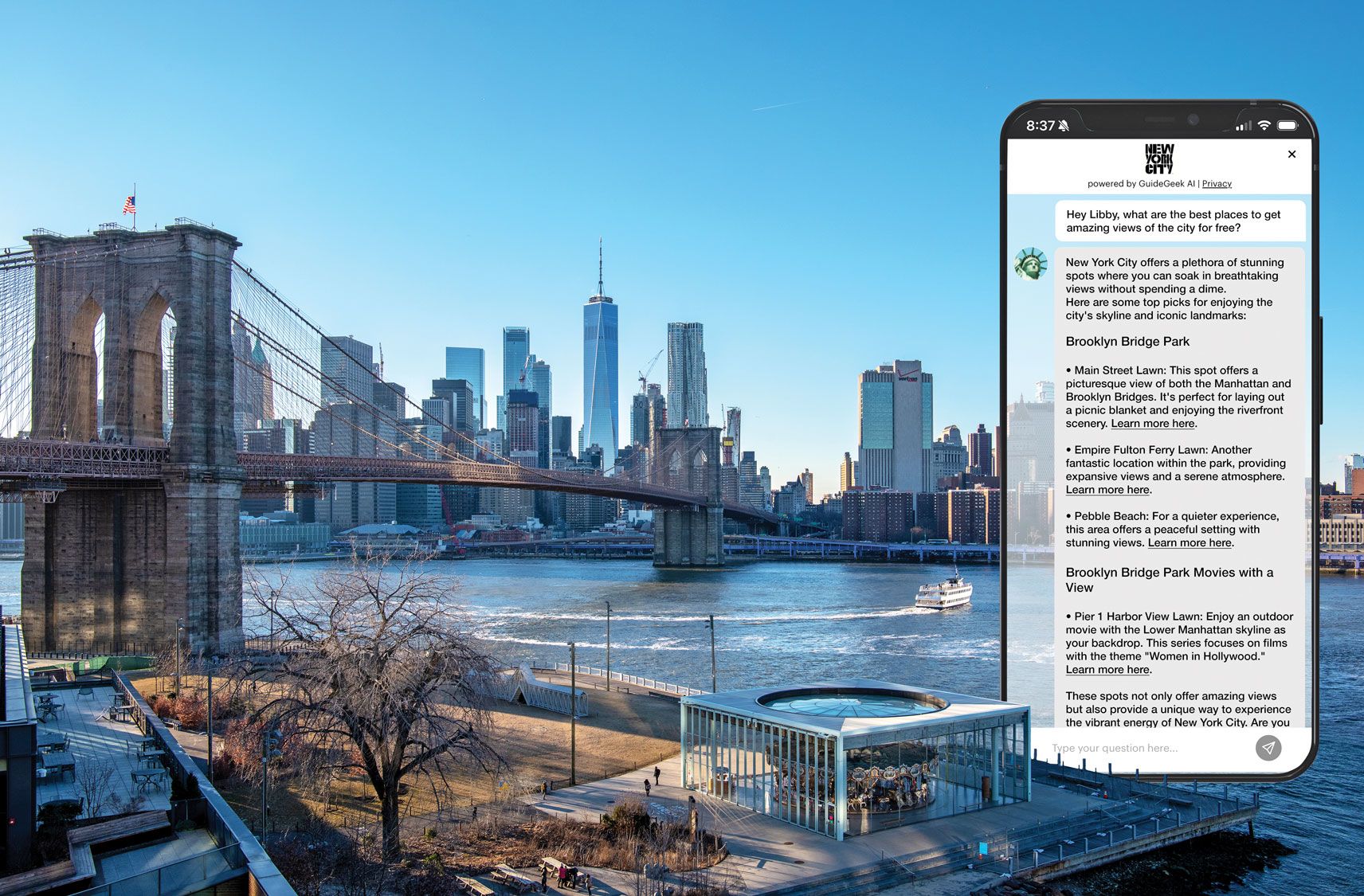
NYC Tourism’s Libby chatbot for leisure travelers operates in 68 languages. (New York City Tourism + Conventions)
NYC Tourism’s Libby chatbot for leisure travelers operates in 68 languages. (New York City Tourism + Conventions)
AI can also try to tackle overtourism.
Amsterdam’s AI crowd-management tool predicts peak periods and diverts visitors away from high-traffic areas to reduce overcrowding. Discover Flagstaff last month unveiled a Tripist chatbot that can recommend itineraries in the Arizona city by using real-time factors such as group size, weather, time of day and traveler intent, offering off-the-beaten-path alternatives to popular attractions.


Discover Flagstaff, the DMO for Flagstaff, Ariz., incorporates AI tools into its marketing strategy. (Discover Flagstaff)
Discover Flagstaff, the DMO for Flagstaff, Ariz., incorporates AI tools into its marketing strategy. (Discover Flagstaff)
Keeping a destination’s residents at the forefront of the AI conversation is critical for DMOs that incorporate the technology in the promotion of their destination, Ekstrom said.
“When it’s used well, AI can strengthen the entire visitor economy,” he said, adding that DMOs can share insights with local businesses so they can improve on their workforce readiness and align messages across different stakeholder groups. “We’re using AI-driven insights about what visitors are expecting to make sure that people on the front lines are prepared to meet and exceed those expectations.”

When it’s used well, AI can strengthen the entire visitor economy.
Destinations as a digital ecosystem
Meanwhile, agentic AI platform Satisfi Labs, which specializes in sports, entertainment and tourism, works with DMOs to track the performance of AI initiatives via its Agent Performance Console, which launched in February. More than 100 clients are using the dashboard to measure metrics like visitor conversions, ticket sales and extended stays.

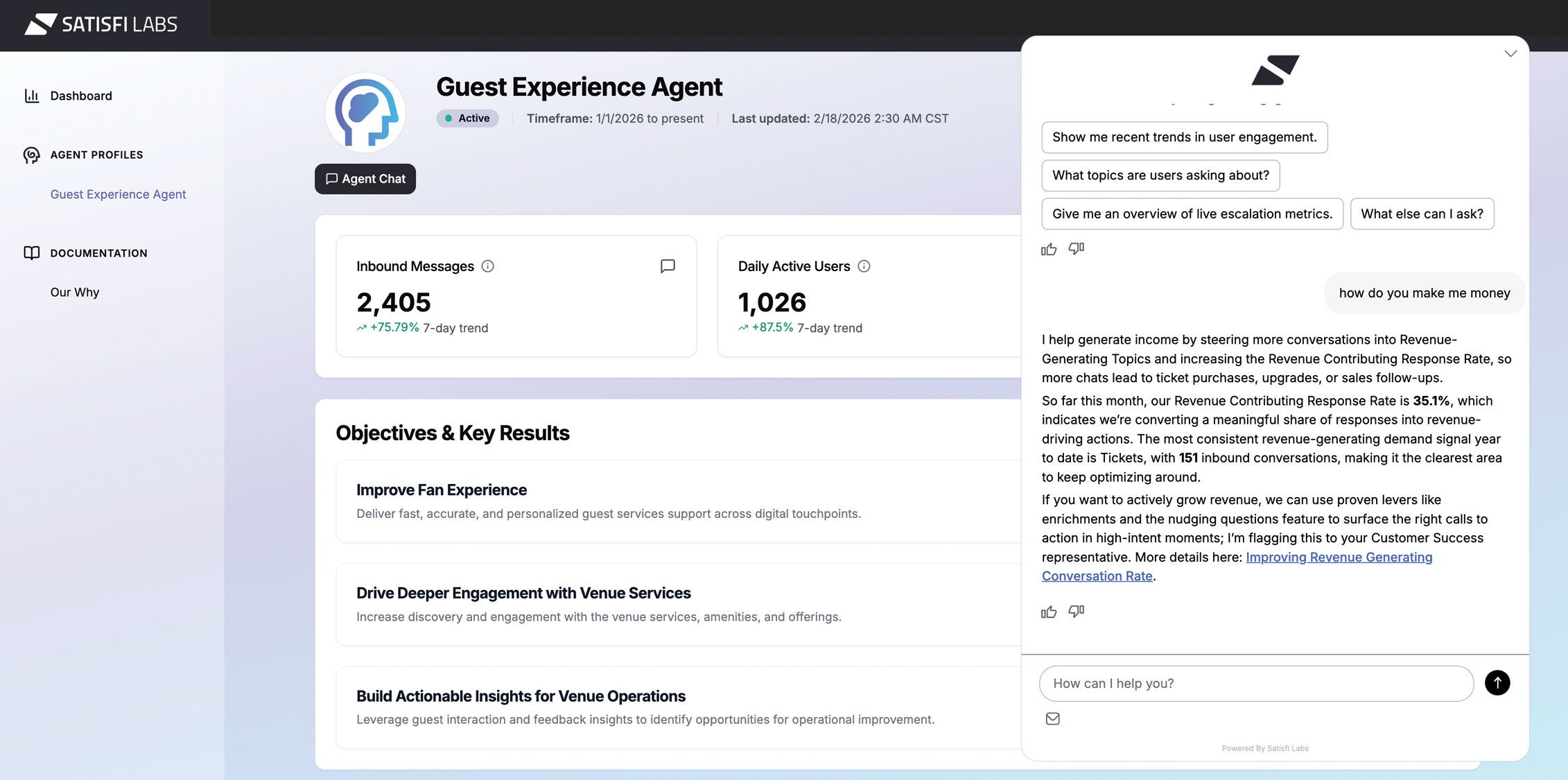
Satisfi Labs’ new Agent Performance Console measures metrics like visitor conversions, ticket sales and extended stays. (Satisfi Labs)
Satisfi Labs’ new Agent Performance Console measures metrics like visitor conversions, ticket sales and extended stays. (Satisfi Labs)
And Satisfi’s newly launched Agentic Cities Program is working to create what Dan Flores, head of tourism, describes as “a trusted ecosystem with AI in the background.”
Experience Columbus is one of the first destinations to pilot the program, which launched in March. The technology weaves together a connected network of AI agents, built on Satisfi’s proprietary platform, across a city’s attractions, restaurants and venues. These AI agents can link back to the DMO’s website or to partner sites.
“DMOs have always helped connect visitors to experiences across a city, but most individual locations still operate digitally in isolation,” he said. “If you look at the journey of a traveler, from search and discovery to end destination, making that all connect together, that’s the goal.”
The idea of an integrated ecosystem — where AI agents across a community communicate with each other in real time to fulfill visitor requests — is what Brand USA’s Roush calls “destination as a service.”
At some point in the not-too-distant future, she said she sees it as a traveler’s reality. For example, if a visitor is in Times Square and deciding whether to first visit the Empire State Building or take the Staten Island Ferry to sail past the Statue of Liberty, an AI tool could pull information from NYC Tourism, the city’s transportation authority, the weather and foot traffic cameras in both Times Square and lower Manhattan.
“It could say, ‘You know what? It’s going to be cloudy at 3 p.m., so you should go to the Empire State Building now, and we can see the lines aren’t as long there as they usually are. Later today, it’ll be cloudy, but that’s a good time to be under the cover of the Staten Island Ferry,” she said. “And this is the train that you want to take to get there.”
Keeping humans at the forefront
Travel advisors, who often work with DMOs to plan a trip for clients, also have a place within this ecosystem, Satisfi’s Flores said.
He envisions that a DMO’s AI integrations could provide advisors with additional resources.
“Why wouldn’t a travel advisor get the information from the DMO’s chat agent to get better recommendations instantly for their clientele?” he said.
NYC Tourism’s Mammana encouraged advisors to view AI as an opportunity.
“The human element still hasn’t gone away, and opinions still matter,” she said, adding that when it comes to planning and booking, a client may go to an advisor prepared with inspiration they found on AI. “You’re just going get a better-informed client. Using that person’s ability to find better information more quickly — and using AI tools — is an ace in the hole.”

Advisors using AI tools to find better information more quickly is an ace in the hole.
However, there can be drawbacks to advisors’ clients using AI. A recent Travel Weekly survey found that nearly one in three travel advisors report having to spend extra time debunking false AI information clients find, while 38.1% of respondents said that managing clients who bring AI-generated ideas has slightly or significantly increased their workflow.
But those cases also give advisors the chance to show the value of working with a human. And as AI tools evolve at a rapid pace, Learn Tourism’s Ekstrom said the same is true with destination promotion.
“Remaining human is what will determine which destinations win,” Ekstrom said. “The destinations that use AI to empower their community, to engage their community and to support their community’s vision for the future are the ones that are going to amplify humanity, and not replace it.”